reabc/Intro to the US An Autonomist Political History - Noel Ignatlev/Intro to the US An Autonomist Political History - Noel Ignatlev.pdf
Web PDF • Imposed PDF• Raw TXT (OCR)






![X Coasider for a momeat what would have bave beca the impact 08 US. (snd worldi) history bad while labor chosca to make commos causs with the great upbeavalof the black tolles of the Sooth? Wil it cver be possibls to know how diffcront might the outcome bave beca had thero cxisted among the thousaads of profcssod Marziss in the cousiry atthe time ovea & small orgasized group that understood the worid historic sigaificance of Black Recosstruction sad contiouiog ‘of lsboe costrol reassested lself. Tho bowrgeoisic was able Loredefine the white skin privilege from that of not beiag s slave to that of kaving soccss to the bourgeois political process. Becauss of he inability of whits sbor 1o 800 ts reflection in the straggles of black poople, lsbor militzacy was \ransformed into fight for white labor’s interests. The ssbecqueat kistory of black/white lsbor cannot be detailed here but » fow lisstrations wilindicate the goneral direction. ‘Within & decads after the comnter-rovlation of 1577, there asus cace againin the South a movemeat which throatosed the sway of capital — this time .-;p--fi-l.—;-.-’-—d—l--_-l-pv coatrol of prices for supplies and farm prodcts. This movement, organizcd b the Popalist Pasty, for time threateaed to blow spart the “solid 10uth” of the Democrats. The biack masses exteaded thels support to Popuism sad at- Serance to white supeemecy. Obscrve the carios spectacle of Tom Walson (he nost promiseat eador of carly Popolism, who was caly allowed to taks hisseat {athe USS. scaate after aving accopted the racet compeomisc, making a speech in defeasc of the Bolsheviks on ome day aad asother in defense of yuching 0a tho following day. fimm*uh_flm‘fimnfl sttained considerabl inflacace over the aeat two docades bohiad the g of itswell b—dpfllfl-l—v.l*-bm-ld byts acocptasce tha the motion politics, cvea radical poltcs, was “whidsmea’s business.” There were better and worss carreats wihia American Socislism (the best broke withit carly 10 joia the Indastrial Workers of the World) but the view was that tho party could gain kgiimacy inthe cyes of the whisc uhlfl].lmiflifllhu_mi-—u acially segrogated locals i the South (whea it admitted blacks at all and falcd](Intro to the US An Autonomist Political History - Noel Ignatlev 12.png)





![1860 1895 1897 1902 1920 1925 1927 1850 1965 1 the e 1860, Pruss dats new el codes aiinaling bomoscnally (aeracepted by Germany) ko as Pararagh 175. KRL-HARA BEAKERT, Hungarian docor, dafsstalenest 1o gvestnen statng Fat paragraph 175 ki “7ghts o man* and caling upon athesies o et the proposa. The code s isated, ngaing newave of omoscal represin. Fra- U175 el ’ Gty e ol ousands upon tousands o homoscnls. CSULIES v s non e ety sl o ndecency it . oo T ecp o G i a5 Testors b e fst . MAGHUS HISCHFELD, & Geman raical sxcogtsarsthe SCEMTFIC HUMANTARAN COMMITTEE it goss o i egiiation 0 e postion of s ishing he anigay parsgraph 175 edghiering bk opiion on honasnady a0 uresing o homosensl hevelnhe e for i ighs™ The SHCbecomesmot acive g advacale oranzaion i Eope, enig awound 1523, JOHN WLLIAM LLOYD pubshes th st sue of The Free Conrade, a polt- callyand sealy radical oural dedicated 0 “reatiog a vrkd here seml. verstyvas vae” It el 15205, WAGHLS HASCHFELDgos onsesking s e scson i e e m e et Gy o Sty ] s cay o e g e [ s e oyt rk T s Do e ko ehenat e Modeld after the rschekd’s SHC in Gernany acivists Oicagform the. SOGETY FOR UMM IGHTS. Theywoukd go 0 o publsh o 555 o RIENDSHP FOR FREEDOM and despie ek delnse o " and ocer”and heirpledge nat 0 et e “pubic welare,” her denies vere oxposed. bythe meda—eading 1o several rests and ses o o formembers. EMMA GOLDMAN pubicy defes WALTWHITHAL I a et s sates: “The. ool donot seem 0 reaize that Wat Whmar’s greatness 2 arebel and et may bave been condiioned i sexsal dileretation, an tathe coud ot b ‘i than what he vas” and sttes publcy hat * regard it a5 3 ragedy that peopie of ieing sexualorentaon fid temseves proscrbed i word at s 5o e understanding of homosexts ™ P —————— B er s s g s ol H Toetie S Th e o e e e o e B T e mergnce of gy s g ke he v, AT s 11950 ay ’ g, gy st becones i e ‘g™ o T s . e o plicay ot gy s paicaio, Sineing Fom atadhine, NE i & e, acping bt vomen s o and e s e S G b DAGHTER O BT & e In 1965, "V Sheaer,” a member of the Oicago Chapierof DAUGHTERS ‘OF BLTS, appeas on’ bo-hour v debate abus honosenlty on ‘Gicago’s HEKB. Th program s cne of the frst imesselfdented homoses s 3ppear o tekvsion, and "M Shearr” s the oy woman feshred.](Intro to the US An Autonomist Political History - Noel Ignatlev 24.png)








INTRODUCTION TO THE
united states
An Autonomist Political History
by
Noel ignatiev
PUBLISHER'S INTRODUCTION
istorywas nkially producedia 1978 s part ofa larger project aimed
at the further development of an international, catra-parfiamestary,
revotutionary political teadeacy. Two satioaal couposcats of this movemeat,
Sojourner Truth Organization ia the US. asd Revolutioasry Siruggle in
Ircland, agreed (0 cachange delegations toward that eod, and as part of this
process each produced a poliieal history of ks conntry.io be distributed on »
‘sationsltour of e other, bost couatry. This i the first U.S. publicatioa of the
manuscript, writies by S.T.0. member Nocl Igasticy, takes to Irclasd by the
ST.0. delegation.
This exchangs was past ofa dialogoe that begs for more. Maay readers wil
find this statcment’s readition of US. bistory of wss ia siudy and discussion
roups, as an analysis that has more then withstood the test of ime and is sl
10 be grasped and appreciaied by most of the lef i this country. But is value,
can best bo measured by the practical dircction it provides on ssucs that
‘contiaue to plague the workd revolutionary movemeat.
Fow relationships ar as iatrigning and poteatially instructive as that be-
twoen ULS. poliics aad the Irish natioaal iberation struggie. This is truc both
because the Iish have such stroag tes 1 the Irishimumigrant population of the
US. working class — aad therefors 10 the U.S. working class s a whole — aad
‘becausc the Irish are Earopean rebels against 2 bastioa of white imperialism,
Britain. More thas a fow U.S. radicals have sought 10 develop this convergeace.
Onetheoryis thatthe Irish can provide a pole of asti imperiaist siruggle amoog
workers of Europeas eatraction in the U, and in doiag so lak together the
US. workens strugglc with Irsh natioaslism and satioasl Bberagion in geacral.
The bridge betweca sat-imperialist struggie, cspeciaily by peopies of color,aad
whic workers wouk tha be bk wpon ihe famevork o the ik fde-
peadence movemeat.
mi.dmul-ildb.nduh—#mmuqufia
of whitc supreasacism. The Iriskimmigrants, with fow czcoptions have chosca
— desphe their loag and bitier stroggle against the Beitish — (o idcalify
themscives as white people. The taraing poiat ia this process was 1842, whea
the Liberator, Dasicl O’Coasell issued an appeal io Irksh-Americass o join in
the anti-slavery movemeat. Thoyangrily rejected his appeal; saying thatif forced
10 chooss betweea love for Ireland and logalks 10 the lastitusios of thei new
‘coustry,they would choose America, which inthat costext meant they chose 1o
be white.
Ignaticv's analysia, truc io both S.T.0. and the interaational actwork it was
part of, also emphasizes theindepeadent and cmsbeyonically revolutionary
haractes of mass working class inlatives. as the wrategic basisfor he develop-
meat of a revolutionary blac of forces in developed capitalist arcas, but sot
without refercace tothe issae of whife sopremacisas. Givea the obstacie of white
‘consciousaess and behavior, the creation of geacral revolutionary stance 0
the part of workers of European desceat depeads fundameatally oa theis
ejcton of whie-ocs in the processof e strggle. I pracice i SeteC
oy prtearian revologary gejec i the US. i particular st be
bascd 0n 8 mass challeage 1o capitalism aod white supremacy
Abseal mh“m“flmfll
mu;pflw-&n-h-.—flnfi-'h*
Mhhdl&'fltflfllb;“dsfih:*
fonbcopuines " of mllionsof workers 0
confroat and overcome while ‘withia the working.
et wille ofsmost importance. Toward hat cad, e presnd s
booklet
Lowell May
Janoary, 1992
PREFACE
|-u=nhpai.|n_mm-'-u.-mnn.d..uu¢m
rom the Sojourner Truth Orgasization spoasored by the Irish group,
Revolutioaary Siruggle. I was inteaded o introduce STO to an Irish aulicace.
Fial Coallict Publishing, which is ropriating il bas beca kind caough to iavile:
me to wrile a sew preface.
The main cortoctioa | would maks i i the treatmest of “the satioaal
question™ 1 cosceded 100 much 1o those who hild that the defisiag coafic of
{he cpoch i betweea oppressiag and oppressc natioas. Thal view, draws from
igaoraace: forcmost among these ast relgion as s locus of he radical tradiion,
b cass strugglo i the 181h ceatury, aad the coatribution of the native pooples
10 American ffe.
10 ot regand tho sbove esumeration as exhaustive.
Noel Ignatiev
June 1991
INTRODUCTION
would the Usied States be ike without black people? The asswer
this question can be found by cossidering a country likc Canads,
whichresombles o U'S. i many way — a vatarea f geat ara esomscs,
sparselysottlcd by aative peoples before Earopean colosization. Canada differs
from the U.S. ia oaly onc sigaificast particular — it was scver givea over to
Afiican stavery, sor was it ever implicatid s the sleve trade. Aad this particular
s 2t boligm respossible for the difforeace betweea oac couniry which has
domiaated world poltica throughost this catiro costury aad todey coasituica
the biggest caploiter of peoples an a world scale, and asother whoss impact 0o
‘workd affairs has beoa far moro Emited.
1, in the documest that follows, we dovoto a great deal o atication to the
bistary of the “race questioa” in the LS., i 80t becauss we arc bumasitarisns
bt becanse we recogaize it as the key 10 the history which has made us what we
aretoday, snd the key 1o any foturo trassformation we bope 1o achiove. It s also
because the mattc is understood by fow people, and sot more widelyinthe US.
than other places.
fimitations will prevest us from goiag into much detail on aay subject;
Space|
Ffi-fiufl'.‘wa—iflfl.fiflfl“&w
we shall spead somo timo ou i
The portion ofthe documeat setting forth the positions of o orgasization
on carreat questions s nccessarily truncated. Wo bops that our treatmeat of
b history will cnablo tho reades to comprobond what we stasd for and bow, ia
gemeral, we proposs 1o proceed.
‘We wish to capress oar gratituds to our comerades ia Revoletionary Stragalo
who have givea us this opportuaity 1o commusicate dircctly with their owa
‘constitteacy, om this occasion of oar 1980 trip 1 Irclasd.
THE SHAPING OF AMERICA
1o geaeral belict, the first African laborens to arrive ia the
. .colonics did not come as slaves, and the first
Iaborers did not come as. free mea and womea. The lsbor forcs in the 1R
century was composed of indestured sorvants imported from both Africa aad
tho Britich Ises. They wero boaded for 8 specified period, ussally sovea years,
‘aficr which thoy became logally free.
The rlers of colosial Viegieia wers faced with twn probleses: in addition
tothe labok shortage, there was the question — who would polics the laborers,
‘who were wot casily recoaclied 10 conditions of scrvitade n a costincal where
Iand was availablo for the taking?
The colonies were not rich enough to support & profcssions! police force.
of safficient size. It was cascatial that ouc part of tho lsbor. force be calised to
police tho other — whilc remaining laborers themsclves. Could Africans Gl that
role? Such a solution would hardly cacourage cmigration from England, o
‘around the middie of the 171k ceatary, to a policy of drawing 8 line betwoea the
mdflfl_hflb—nmm — the first being the
‘of femalo Earopean boad laborers from Beld work — were coo-
ferred on the former, whils special laws wore passed o fix the status of the
Alfticans: exteading the term of servitudo untl i bocame permancat end thea
coloay proletarians
1ospecifythat white bond laborers finishing ther period ofindeatur be givea
amisket, What a changs froe barely a goacration earfic, whea rebel forces —
l-n—ul“h—w.np-l“-flfl-dddnflfll
of Jamestown aad seat the governor flociag across the Chesapeake Bay, the
same bond Iaboress who, betwees the years 1663 and 1682 hatchod 0o less than
3
war of a rising bourgeoisie against the forces of foudal sbeotutism, but instead
2 conflict botweea the merchant class of New Eaglaad (alfied with indcbted
southern planters) and the coloaizing power over who would reap the vast
rflldhhwflhn-finfl‘bh&lu—dhh—
trade” described by slaves captured in Africa, rum aad tobacco
in the West Indies, and masufactured goods from cither Liverpool
"Tho decades folowing the establishmest of the American Ropublicsawhe
emorgonce of two systome of cxplokation: direct laveryinthe South, supportiog
the cultivation first of tobacco aad later of cottos; and masufacturo based 0
wage labor in New England sad the Middic Atlastic statcs. The bistory of the-
US. for the balf-contury preceding the Civil War is » history of tho growing
cacroackment of the slaveowser's power oa the foderal government. The
‘Seminole Wars, which were foughtia Florida from 181910 1821 sad which were
efforts to recapture slaves who had cscaped 10 join local Indian tribes; the
Missour Comprise of 1820, which cxtoaded slavery 1o tho westera tcrrtosics;
tho 1636 fo 1848 wars to wrest from Maaico the vast arca that today maked up
the statcs of Texas, Now Mericn, Asizons, Cafiforsia, Nevada aad Colorada;
tho filibestering in Central America sad the efforts 10 xaacx Cubs, the Kensas-
il
Republicas Pasty, arouad a program of opposig the cateasion of slavery into
mew territorics. Whea the Ropublican Party woa the cloction with & bare
plurality of votes among four major casdidates, the lmponding coaffict bad
irvopressible.
Tho Civil War began with both sides fighting for slevery — tho South to taks.
it out of the Unios, the North to keop it in. The real sim of the South, bwever,
was 30t 10 secodo from the Usioa but, by scccssion aad war, to reorganizs i on
» now basis, with tho “pecaliar institution,” slavery, as.the fousdation of sa
‘cmpire stretching from tho Great Lakes to Costral Amesica.
“The sims of the sorthers masnfacturing bourgeolsic were modest: simply
1
This stage did not lst long, Two things brought about a change. First was
e itttude of the whites ealisted ia the Unioa cause. They opposed the spread
of savery and the breakup of the Usioa but were hardly enthusiasié sapporters
of & war that was bringing them eatremo bardsip while caricking thelt
cmployers through governmest coatracts. They showed thels feelings carly by
‘ascries of draf iots i New York, Cincinatt and elsowher that commonlytook
e form of mob attacks oa fre biscks.
“The second factor making for & changs in governmnt policy was tho role
of tho blacks themselves. Por decades,frea blacks had beco the mainstay of the:
‘emall organizations advocating the abolition of slavery, and the escaped slaves
‘means ofsriking and resisting the exploitation, including lauaching numerous
revolts, the most well known led by Gabeiel Prosser, Deamark Vesey and Nat
Turnes. Now, s the War bogan, the biack people began tosco i as partof thelr
struggle for froedom. Froo biacks In the North anderstood that the casse of
‘shoition was linked 1o a Union victory, in spite of Lincola's protestations that
bo bad 5o astslavety alims. Whils préssuriag the government ot al lovels to
‘broadeathe War tooae againil slavesy, hej began toealistinthe Uion ermics,
oftcn against iant obstacles placeil inthc way by the governmeat which did
‘ot want them as sokdicr. The famui oo, Jokn Brown's Body, commesmorat-
ing the great revotutionary abolitionist who gave his life. strogging sgainst
7
lavery, was written and suag by the Massachusetts S4th Regimeot, oac of the
1l black uaits (commanded by white officers).
A first the slaves watched and waited; it was not yet clear where thei
‘atcrests lay. So loag as they worked the cottoa, the South could place ia the
icld of battle a disproporiioastc aumber of-its white mashood. The first
pics for the Union amics.
By 1863, the alicmpt o wage & war against » foros whose streagth and
veakncss. both lay ia the institution of slavery brought sbout a chasgs in
acola's policy. This was manifestia s things: firs, the adoptioa of a morc
ctive military policy; second, the decisioa 10 cacourage the calistmeat and
\ring of Blacks; aad third, the declaration of the sim of the war o be the
‘bolition of slavery.
It should be soted that Lincola's famed Emancipation Proclamation frecd
0 0ac: it mesely declarcd slavery sbolished in thoso arcas thea ia revol, that
+ 1hose arcas where i could sot be calorced. But ss a statcmeat of inkeal, i
s caough 10 “loose the fateful lghtaing” — tho six buadred thousand biack
sborers who cmbarked on a great working class upsurge, beginaing in 1863,
aass withdrawal of Isbor power — & geaeralstike — which quickly brought
he South 1o ts knces. :
THE AMERICAN COMMUNE
y 1865, the war was over. How 10 recomstryct tho satioa? To restore
BB averywas o ofthequestions tho senlytwo hundredtbousand blcks
vio bad fought in the Juioa armies asil the yix huadsed thousand more who
hreaseniog 10 retur to Coagress 1o‘ackicve thero ‘they-
«chicvo on the batileficld: withdszwa) of fedcral roogs from the South, valida-
ion of the Confoderate debl and vestoration of stavery ia 3l but name.
Lincoln and his successor as Presideat, Asdrow Jobasoa, atiempted to
‘vason with the focmer slavebolders, affcring to readmit the Southern staies 0
b Usioa with the sole condition that they formally accept the abolitioa of
davery. Wheni#t became clear that the prrogan lords o the lash had o nication
o submitting evea to this mild demasd, public opioios tugpéd toward a morc
iransigeat policy of reconstructior.
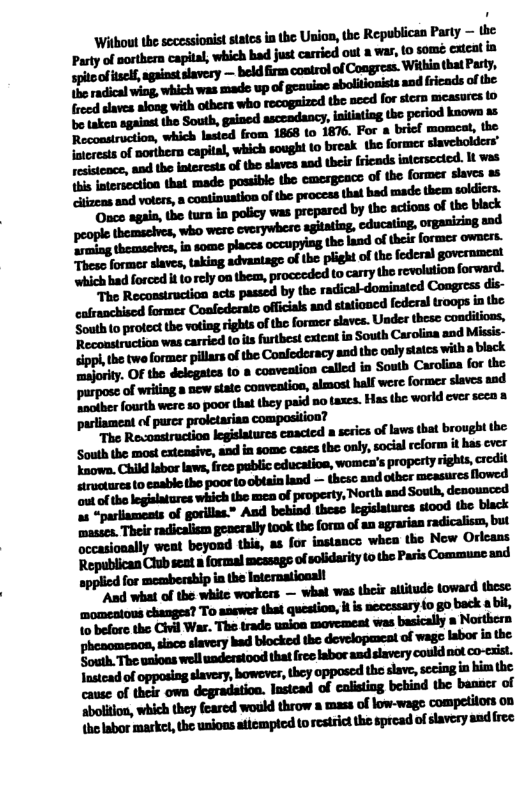
Wilbout the sccessionis states inthe Usion, the Republican Party — the
Pary of sorther capial, which had just caried out was, to somé cxicat in
il ac, agint lavery — b firm controlof Congres. Witk that Pt
B eaiical wing,which was made up of genuias sboliionists sod fricads o the
frend slaves along with others who recogize the need for sterm measurcs (o
b takca agains the South, gained asceadancy, iitating the period kaows xé
lm-uuufi_mmlmru.ku—u.m
reress of nortbern capilal, which sought 10 break the formes slaveholders’
eitcoce, and the Intgrests of ho slaves and hes friends intersccted. It wos
{is Itersection that made possible the cmergeace of the former slaves o8
of writing & new state Mhll‘m!ov‘fl*und
P eiher fourth wese 80 poos that they paid no taxes. Has the world cver sccn &
partiament of purce prolctarian 7
The eaacicd a sorics of laws that brought the.
10
Iack Iabor as well, by suppostiag the Freo Soll (for whiles oaly) movemeat. On
se very eve of the wa, the usioas took 8o official notice of slavery, rogarding
, at best, as a subordiaate past of the gencral labor question, less importaat
1an minor legislative reform. Whea the war broks oot instead of embracing
1c cause of the slaves as their own, white labor had to be dragged by the
ourgeoisic kicking and screaming isio the war, cspecially aftr the first wavo
uild its owa party, bringing it isto direct coaflict with Southern blacks, who
adin many places transformed the Republican Party intoa Isbor party a fact
‘ooking at the masses of newly freed slaves, whits labor saw them not as part
their own class bt as competitors and poteatial scabs, and sttcmpied to
them — whea they agreed 10 admit
scats of the Reconstruction governmeats they
tention oa the charges of corruption asd oa the so-called waste of statiosing
deral troops in the South.
‘What was troe of the wsion moveameat was, sadly, also troe of tho disciples
oug! influcatial
‘ananimously saw the spectcr of rovolution. 1 was both symbol snd
substance that the troops butlod agaiast the sirikers wero in many cascs the
ilitaryunits that had reccatly been widhdrawn from the south. In St Louis the
workers, under the leadesship of the Workingmen's Party, wead beyoad the
\eisare of the terminals and began to xercise powe ia tho city through mass
asscmblies!
X
Coasider for a momeat what would have bave beca the impact 08 US. (snd
worldi) history bad while labor chosca to make commos causs with the great
upbeavalof the black tolles of the Sooth? Wil it cver be possibls to know how
diffcront might the outcome bave beca had thero cxisted among the thousaads
of profcssod Marziss in the cousiry atthe time ovea & small orgasized group
that understood the worid historic sigaificance of Black Recosstruction sad
contiouiog ‘of lsboe costrol reassested lself. Tho bowrgeoisic was able
Loredefine the white skin privilege from that of not beiag s slave to that of kaving
soccss to the bourgeois political process. Becauss of he inability of whits sbor
1o 800 ts reflection in the straggles of black poople, lsbor militzacy was
\ransformed into fight for white labor’s interests. The ssbecqueat kistory of
black/white lsbor cannot be detailed here but » fow lisstrations wilindicate
the goneral direction.
‘Within & decads after the comnter-rovlation of 1577, there asus cace
againin the South a movemeat which throatosed the sway of capital — this time
.-;p--fi-l.—;-.-'-—d—l--_-l-pv
coatrol of prices for supplies and farm prodcts. This movement, organizcd b
the Popalist Pasty, for time threateaed to blow spart the “solid 10uth” of the
Democrats. The biack masses exteaded thels support to Popuism sad at-
Serance to white supeemecy. Obscrve the carios spectacle of Tom Walson (he
nost promiseat eador of carly Popolism, who was caly allowed to taks hisseat
{athe USS. scaate after aving accopted the racet compeomisc, making a speech
in defeasc of the Bolsheviks on ome day aad asother in defense of yuching 0a
tho following day.
fimm*uh_flm‘fimnfl
sttained considerabl inflacace over the aeat two docades bohiad the g of
itswell b—dpfllfl-l—v.l*-bm-ld
byts acocptasce tha the motion politics, cvea radical poltcs, was “whidsmea's
business.” There were better and worss carreats wihia American Socislism
(the best broke withit carly 10 joia the Indastrial Workers of the World) but the
view was that tho party could gain kgiimacy inthe cyes of the whisc
uhlfl].lmiflifllhu_mi-—u
acially segrogated locals i the South (whea it admitted blacks at all and falcd
"of thi contury a5 & self-conscious rovolutiosary movemeal, in many
b best and most succossful revolutionary organization the coustry
e oown since the cading of the Reconsruction, broke with the pervasive
o ol the American Federation of Labor. (rish readers may be famliar with
{he TWW, since James Coaolly was an active membor during his sojourn a the
US) Yet these efforts,inspite of some successcs which we Lreasure, wore nE1 e
fihhfihbfi‘fliflhfitlflifll&-fli&u—dpflhfl-fi
tied it to capital.
The CP, which began the decade as an organization of sbout 2,000 peopi,
most of whowm were foreign born and noo-English speaking, kad an importast
e o the course of eveats of that time. It came to nation atteation
{hrough ls role n scveral impostant stikes, pasticulasly in the San Francisco
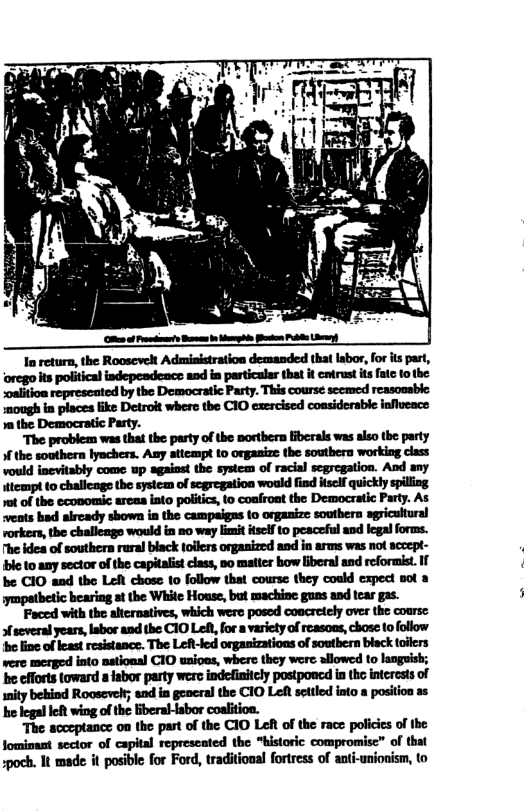
1 the Democratic Party.
The problem was that the pasty of the nortbern iberals was also the party
the southern lynchers. Any atiempt 1o organize the southern working class
vould inevitably come up against the system of racial scgregation. And any
ttempt 1o challenge the system of scgregation would find itsclf quickly spiling
1ot of the economic arcas to politics, to coafront the Democratic Party. As
vents had aircady shown in the campaigas o organize southern sgricuitural
vorkers, the challenge would in 20 way it itself t0 peaceful and legal forms.
The idea of southern rural black tollers organized and in arms was not scocpt-
ble o any sector of the capitalit class, 0o matter bow liberal and reformist. If
be CIO and the Left chose 1o follow that course they could expect sot 8
hearing at the White House, but machine guns and tcar gas.
Faced with the altcrnatives, which were posed concretely over the course
several years, Iabor and the C10 Left, for a variety of reasons, chose to fllow
e fine of least resistance. The LeR-Jed organizations of soutbern black toiiers
were merged into nstional CIO uaioas, wher they were sllowed to laogusk;
e cfforts toward a fabor party were indefinitcly postponcd in the interests of
ity bekind Roosevelt; and in general the C10 Lot settled into a position as
he legal left wing of the iberallabor coalition.
The acceptance on the part of the CIO LeR of the race policies of the
fomimant sector of capital represcated the “historic compromisc” of that
spoch. It made it posible for Ford, traditional fortress of anti-unionism, to
a bief history ofthe stonewalliots
' and other queer happenings
True Leap Press & Distributic.
P:O. Box 408197
Ciicago IL, 60640
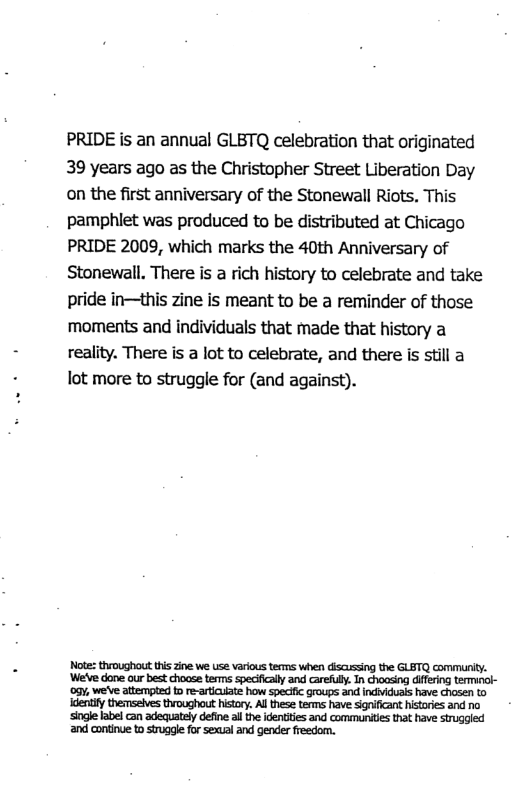
PRIDE is an annual GLBTQ celebration that originated
39 years ago as the Christopher Street Liberation Day
on the first anniversary of the Stonewall Riots. This
pamphlet was produced to be distributed at Chicago
PRIDE 2009, which marks the 40th Anniversary of
Stonewall. There is a rich history to celebrate and take
pride in—this zine is meant to be a reminder of those
moments and individuals that made that history a
reality. There is a lot to celebrate, and there is still a
lot more to struggle for (and against).
Note: throughout tis zine we use various terms when discussing the GLETQ communty.
‘We've done our best choase terms specfically and carefuly. In Ghoasing difering terminck-
oy, we've attempted o re-aticuiate how speciic groups and indviduais have chosen o
identity themsaives throughout history. All these terms have significant histores and no
‘single label can adequately define all the identities and commurites that have struggled
and continue to siruggle for sexual and gender fresdom.
In the late 1960s and the years prior, gay tars
served as one of the very few places that gay, lésbian or trans people could
gather with one another, However, even these spaces were often unable to
‘provide homosexuals and gender-variant individuals with the opportunity to
‘comfortably and safely gather. Often times, they were owned by straighit men
and/or connected to the mob and were looking to make money at the expensa of
the gay community rather than serve it. Gay bars were also regularly subjected
to police raids as most states had anti-gay laws, induding statues regarding
“gender-appropriate” dothing and laws making it a crime to serve alcohol to a
‘homosexual. Along with these faws that were on the books, pofice forces would
find additional excuses to take out their anti-gay hostility. These policies reflected
larger culture of homophobia and anti-gay sentiment. There is a long history
of anti-gay laws and regiression, and there are multiple stories of gay activists
through history, but by and large, there had been littie public action defending
the rights of gay, lesbian or trans peopl. There were some writers and activis
who would speak out in defene of gay Issues or publish underground newspa-
pers like Friendship and Freedom, a paper printed in 1924 by the Sodiety for Hu-
‘man Rights here in Chicago, which led to members being arrested and fired from
their jobs or Emma Goldman's adamant defense of Walt Whitman in the 1920s.
But the fact remained that for decades, those who spoke out against
homophobla were faced with being ostracized and jailed.
Beginning in 1950, 2 new wave of activist groups began to
form, and became known as the “homophile” (a pre-
Stonewall preferred term) movement.
The first group that was formed was
the Mattachine Society, a gay mens
organization that began to work against.
the various ant-gay laws along with
greater society’s anti-gay bias. Taking
aim at the law prohibiting the sale of
Tiquor to homosexsals, in 1966, Matta-
chine organized “sip-ins” in which they
‘wold order drinks at “stright” bars and
announce they were gay with intention of
exposing and suing the discimiate bars
as well a5 the State Liquor Authortty.
Tn addition to Mattachiie, there were various.
other homophile organizations, notably ONE,
Inc. and Daughters of Biftis—perhaps the
first lesbian actvist group. Whike each group,
In their own way, responded to the extreme
homophobia that ran deep in the farger
culture, the prominent strategy within the -
‘homophfle movertient was an attempt
to be accepted by mainstream society.
‘Women involved would always wear skirts
stockings and the men would wear suits. Public displays of affection at homophile
‘actions were typically condemned for “hurting the movement.” This approach to
2 politics of difference often distanced the movement from more radical politics
10 avoid being frther marginalized by the mainstream. This was the prominent,
though challenged, cimate of the pre-Stonewall activist movement.
In discussions of gay history, Stonewall has often been treated as a spontaneous
‘combustion of frustration, anger, and joy with a particularly rebellous attitude.
While this s all true, the rebellon at Stonewall was also a development of and
reaction to the previous movements for gay rights. It is also important to view
Stonewall n the context o the e, as resistance movements were developing
Itemationally and uprisings, rebellions and riots were oczurring with reguiarity.
ipture that permanently impacted the.
struggles around gender and sexual identity, it is important to discuss what actu.
ally took place at Stonewall Inn and how it helped to push a movement forvard..
ey
the mssters table.
have to be established fa coloates, a colony ia no more th
s vith conson c
ractertatics or faterests
octatt
(progects) or a gr.
fnstitucionalized avay f
others (
At the fatetal stage of 1
ctrination the masses ace
tastructed fa
fundanentals or rudin
artisas
PoLat of view or prisciples, e.g. o
certain to be favorable to the
e parchologteally
e that the payehological
© occucs, certain segaents ace traduced, expossd to
oc blams by acans of fal
Dr. Na'te Akbar states tn his
of Sele"; "Duriag ol
k eatitled "Comsuntey
7. the ¢ 1biltey for our lives
e
9 from us 20 that va vould accept the authority of the
easlevars. The taformstios and ¢
and cultural exparience vas sileaced by the slavemssters. If
© ova history (ancestors),
our owa culturs, then ve could have remsined
“Preston vas not given willtagly, be 1t
taken from
As stated sarlier the preliatsary prestss of the alite
1s establishisg supertority. Ta order to
ack Holocaust® states®
uc labor 414 thete
thetr tercor van
°n us globally, they continued to push some strange form of
Chetoctantey ¢
1o
ce at the he
Hovever, chelr
version of Christianity alloved thea to slaughter our paople
s
the globe.” Del J
o supec-whit
@84 asn fron uncle and other
© sptes. Star
(space tapectaly,
), Tnat
Jos
. aad other tasges of super vhite power vere p
Thia a11
Ceaceh taper-
elpa to creste a fear ia Black folk of the *iavincible
tne u
7 taages® on ay &
tlon dalivared the idaology of tapectall
. undetected by the
adults of that tise. Now days, the media diet of "good copa®
aced the covboy flicks,
1a the fora of sct
violent viewal
of the populace.
“violaace 1s as Amerikkkan as apple pi
' all of that, let us peer fato tha he
aspication, tear
of white pover (the bo
bureascrats, police, stc.). Deaper
1a the ca
ot the a1
& "Niggers ata’t ahfe® acete
placed by years of
eL-Africa sent vould
>
be o rect faar of the o an alacst terataal
econoatc 1
cuctey. Lead to ste
a1 11100
From the beginaiag of our Lepriscnment uatil today, ve
are still held captive to fala
10 ataed to
paychologteally
The facads of equality, from the very start
conciltate until aew vays could
desoralise 1a &
18 the extrese expression of the capitaltstic
claliee, fasciat g o o egocentele sch
o parpetually cause to an uncontrolled
Almost immediately following the Stonewall rebellion, organizations began to
develop to fight for gay liberation. Just weeks after the riots, in July 1969, queer
activists met in New York City and formed the Gay Liberation Front (GLF), a
radical organization that connected the struggle against gay oppression to ather
sodial movements active at the time. They identified the movement as connected
to the women's iberation movement, the anti-war movement, Black Power
r0ups and stood in solidarity with intemational resistance movements.
A few months later, a group of activists it off from GLF to form the Gay Activ-
ists Aliance (GAA), which was more of a single-issue organization focused on
g3y and lesbian rights. Although GAA didn't associate themselves with the radical
Poitics of the other social movements of the time, they did incorporate many of
the direct-action and civildisobedience tactics. They often utzed sitins as part
of their campaigns to end anti-gay policies of politicians, government institutions
and media outets.
Unfortunately, many of the gay organizations falld to adequately deal with
gender Issues and individuals founded their own groups t address their speciic
needs. Radicalesbians was a lesbian caucus of GLF that spit off and became
its own organization and similarl, female activits left GAA to found Lesbian
Feminist Liberation. There was also a group named Street Transvestite Action
Revolutionaries (STAR) that was founded to provide necessary services (ike
dothing, food and housing) to homeless trans and gender-variant young peope.
living on the street, many of whom were involved in sex work. STAR also pushed
existing gay groups to include transvestte and drag issues in their campaigns,
as the gay organizations wouid often exclude them to appeal to politidans and
straight citzens.
“There were ai number of groups active in the 1980 and 1990's that embraced the.
radical poltics and direct action tactcs of the early gay iberation movement.
In 1980', activists founded AIDS Coalition To Unleash Power (ACT-UP), an or-
‘ganization that used cvil disobedience and large spectacies to fight or behalf of
those with AIDS, most of whom were gay men. A few years ater, Queer Nation
developed which included some former members of ACT-UP and continued ACT- |
UP legacy of radical street actons, In 1992, the Lesbian Avengers were formed, ;
with chapters starting across the country. This direct action group dealt with issues
‘specifically of interest to lesbians, while developing a strong analys's of gender,
race and dlass issues.
Stnewat-Harta b
Outofthe st Wi of Gy Lberasion- ars oy a Kb Yo
el Vs AR rom e gazin by Picee Brosi
sordne—t gt
“Outofthe Coses and it he Liaries” - e compied by bangarang colecive
‘e dveladabie . M fmwngeocites comlthebangarangcotecive ot e
1860
1895
1897
1902
1920
1925
1927
1850
1965
1 the e 1860, Pruss dats new el codes aiinaling bomoscnally
(aeracepted by Germany) ko as Pararagh 175. KRL-HARA BEAKERT,
Hungarian docor, dafsstalenest 1o gvestnen statng Fat paragraph 175
ki “7ghts o man* and caling upon athesies o et the proposa.
The code s isated, ngaing newave of omoscal represin. Fra-
U175 el ' Gty e ol
ousands upon tousands o homoscnls.
CSULIES v s non e ety sl
o ndecency it . oo T ecp o G i a5
Testors b e fst .
MAGHUS HISCHFELD, & Geman raical sxcogtsarsthe SCEMTFIC
HUMANTARAN COMMITTEE it goss o i egiiation 0 e postion of s
ishing he anigay parsgraph 175 edghiering bk opiion on honasnady
a0 uresing o homosensl hevelnhe e for i ighs™ The
SHCbecomesmot acive g advacale oranzaion i Eope, enig
awound 1523,
JOHN WLLIAM LLOYD pubshes th st sue of The Free Conrade, a polt-
callyand sealy radical oural dedicated 0 “reatiog a vrkd here seml.
verstyvas vae”
It el 15205, WAGHLS HASCHFELDgos onsesking s e scson
i e e m e et Gy o
Sty ] s cay o e g e [ s
e oyt rk T s Do e
ko ehenat e
Modeld after the rschekd's SHC in Gernany acivists Oicagform the.
SOGETY FOR UMM IGHTS. Theywoukd go 0 o publsh o 555 o
RIENDSHP FOR FREEDOM and despie ek delnse o " and ocer”and
heirpledge nat 0 et e “pubic welare,” her denies vere oxposed.
bythe meda—eading 1o several rests and ses o o formembers.
EMMA GOLDMAN pubicy defes WALTWHITHAL I a et s sates: “The.
ool donot seem 0 reaize that Wat Whmar's greatness 2 arebel and et
may bave been condiioned i sexsal dileretation, an tathe coud ot b
‘i than what he vas” and sttes publcy hat * regard it a5 3 ragedy
that peopie of ieing sexualorentaon fid temseves proscrbed i word
at s 5o e understanding of homosexts ™
P ——————
B er s s g s ol
H Toetie
S Th e o e e e
o e B
T e mergnce of gy s g ke he v, AT s
11950 ay ' g, gy st becones i e ‘g™
o T s . e o plicay ot gy
s paicaio,
Sineing Fom atadhine, NE i & e, acping bt vomen s
o and e s e S G b DAGHTER O BT & e
In 1965, "V Sheaer,” a member of the Oicago Chapierof DAUGHTERS
‘OF BLTS, appeas on' bo-hour v debate abus honosenlty on
‘Gicago’s HEKB. Th program s cne of the frst imesselfdented homoses
s 3ppear o tekvsion, and "M Shearr” s the oy woman feshred.
1969
' 1970,
1971
1973
1977 .
1987
1989
1993
InJuly 1965, STONEWALL;he.GAY LBERATION FRONT (GLF) s
Fotte fes{ i, 6LF coonecs the 8 BTQ saugge wih ot adial
‘Commuriies, ching e Blagk Powe oistent,and conv=s he suggle
ol mvener by bghring s o S ard bt
e oergpnoms o g 1960, GLF speters, and GAY
fomed.
the STREET TRAVSVESTITE ACION REVOLUTIONARES (STAR) s ounded in
RC by SYLVIA RVERA and HARSHA P 10HNSON. They make comectons wih
the radial grops,rotably the Young Lvcs, 2 Puerto Rean
rison Wi e P s enenon )+
o commeraorate he arviversary o the Soneval rebelfon, gay actv-
st organiae| ‘STREET LIBERATION DAY fo ke pace on ke 28,
TO70 A ANC.Evets to take place i LA, S Franico and here i Cicago.
‘where about 200 peaple march hroogh downonn Oicago.
‘Starting in 1570, gay Rberation acihvists i protesting the Amesican Ps
chiatric Assodiation (APA) kel ok
(GMAbegis wesky dances at the Frehouse, heir NYC headuarters. Dances
become findraser o 2 we a5 recruiing ol
The work of gay acthists pays of and the AP remaves homosesualy bom s
ol
Acbists acus the counry ke acion agaist pp singer and formesbeay
e LB ot S D ey s ooy o
B s & oo vy ooy o
‘vere tather performance s Gtgted. A a press i Des Moes,
Vo, gy St rows 2 pl b e foce at hich poitshe ras forhin o
e “deieredrom s devart Hste” 30 brss o tears.Acons e bese
permanenty Camage ber pubicimageand arer e gbarizing gy acivst
. ACHUP stages a demnsiraion agant the lackof acres o overpriced DS
i i 300 siog o vt ki s o St vl
s Sy o e PO Canisions: To PO e s s
o o o e .
OnSeptensis 4GP esbers gt o ok Sock Extarge
P iy e
A5 medaon T be e it e
prieey ;
el Paai
SN NS 2 P e e
marchtrough Hew York Oyt Hghight the sves soecic o
and eate aradealaerathe o the maistrea, mae-based Pride
even, R ke place ot beloe the Pride Parade and the cvnt
ontinues o bappen eachyea i cies aross the counvy ncucing Chcage.
f
et dcae s s emendocs e i GLET e, i couness argnznors, v
;s rape g achn o oy s Hop e i Foree:
the same peiod has seen Sigrcar atck against
b ey 25 gay queer and gendervark-
ant. Theseatacks ave been physic, lega, pfical ansocl and e ocarred on many levels around
he word The srugge anfives The hture s umwiten.
Truje L,
oo g Press & oy
Boxsggg, T Uon
IL, 6064¢:
the struggle continues.
the future is unwritten.
PO, Box 408157
Cnicage L. 60646
[T Sy a——
VEATH SCHTE & 5440 THOMSON 2000
SOUTLYEAHEGHAL N | BRACITIONSONGHOTIALCON
@it cpyit T ey be b it o gt b ccmertpapess:
incorporate the unioa inlo The system of industrial legality as sooa as it won
recogaitionin 1940. 1t casbled labor to playts role as part of the Grand Alliance:
tha sicered the country through Workd War IL It led o the emesgeace of the
coalition of bourgeois liberals, the official Iabor movement and Negro refor-
‘mism which has dominated US. poltics o four decades asd coatinues to do
5o, although its stabilityis sow shakea.
Politics as serious business disappeared with the cemeating of the “historic:
‘compromise” of the late 1930's. Whea real politics reappeared oves two decades
Tater, it was largely due 10 the refusal of black people 10 accept asy loage the
results o that compromise. But we shall tak that subject later.
‘We now turn to several topics which are amoag those ofica raised by
Lefists and which reveal some of the distinctive features of the US.:
the question of the labor pasty,the question of faciem and the national question.
THE LABOR PARTY
bas the US,, alonc among the developed countrics, failed to
produce a mass labor or sociakdemocratic party? Is American
prosperity so overwhelming or arc U.S. workers so backward that they have fel
‘noncedtotake any nitiative that would lcad them out of the rwo major capitalist
partics? Wo belicve the answer lics clicwhere.
What s a labor pasty? It is the exteation of the legislative arcaa of the usual
tradc unioa practice of bargaining for better terms in the sale of labor power.
It seprescats a coatisuatioa of efforts o impeove the conditioas of the workers
withia the frame work of the wags system. Thus, whilc a struggle for a labor
party can embody greal mass eacsgy and evea revolutionary potcatial, ia its
realized form it represeats class collaboratioa.
USS. workers, by aad large, bave managed to achicve withia the two-party
sysicm much the same degres of influence and social reform legislation that
their European counterparts have achicved through mass social-democratic
and comiinist partics — ia some arcas, more. In many respects the CI0 was
more party than usioa: aside from drastically aliesing the face of industrial
villages (c.g Gary, Indiana and Flint, Michigan, major steel and auto manufac-
turing centers respeciively; i such places the police are 5o loager called out
1obreak strikes, and workers arc not cvicted from their bomes during strikes of
layoffs) the C1O also managed to acquire oa natiosal scale influcace withia
the Democratic Party equal Lo that of the unioes within, say, he British Labous
Party. OF course this political influcace is coaditiooed, as it is in Esgland,
Germany, the Scandasavian coustries, France and ltaly, oa the usioas agrecing
10 coafing their reform efforts to limits accoptable 10 capital, cvea if ot fo
paticular capitalists at pasticular momeat. As has already beca cxplained, i
the USS. this means specifically avoiding a challcnge o the white supremicist
contract oo which bourgeois begemoay rests. Thus the uaions, both in (heir
‘economic functions and in their political activity, bave at best striven (0 redress
some of the most glaring “excesses” of while racise, whilc lcaving intact the
16
fundamental compact on which white racism rests, namely the black, brows
yeliow and red interests hall be served oaly after the aceds of tbe while
‘workingmea bave beea fullilled. As sddiioal poiat: in uo other developed
country is there such widespread cynicism toward the clectoral process as ia
the U&nkmmh..‘d_‘flflmdmmfl&--dlk
catisre population that all politcians sical aad take bribes, that poliical partics
arc motivaied purcly by vulgar scl intcrest, and that pothing of rcal valuc can
com from the parliamentary game. The proportion of cigible votcrs choosing
10 cast a ballot has steadily declined, and it I likely that the upcoming presidea-
{ialclections will witaess for the first time the noa-volcrs oulsumberiag the volc:
totals of ll the candidates combincd. )
Givea the observable cynicism of the American voler toward bourgeois
politics, together with the decply ingrained national tradition of Lawicssacss,
i conceivable thal the working class will cver go througha labor party phase,
or else that it wll give risc (0 a labor party as a side product o the cmergeoce
of revolutionary dual power forms. Oa the otber hand, there is possibilty that
the black movemeat may sucreed in lunching a mass black party; there bave
bee sigas of this development on and offin receat years.If hat bappesed, it
would represcat the esscatial clemeats of alabor party,regardicss o it lsbel,
‘and we would orieat toward it wholebeartedly.
FASCISM
Emhmusuhwmmmumwu
contract on which bourgeois rest. Denial of
supecomacist
rights t0, and violence against, people of color is ot fascism but the ordinary
opesation of bourgeois legality in the U.S. Isdeed, this violeace is preaised not
on the deaial of bourgeois rights to the rest of the populatioa bul on the
continuance of these rights. Groups like the Ku Klux Klan, esisting through the
most savage violcace cven the sightest concession (o people of color, bave bad
s their aim not the desiruction of usioas, constitutioaallegality, tc. but thelr
mainteacace and streagthening — for whiles oaly. (For cxample, in onc fiflcca
year period in the last ceatury, there were over fifly sirikes on the soutbern
railroads with the aim of driviag the black workess out of the industry and
sirengthening the bargaining positioa of the white uaio ia rclation o manage-
‘ment. Even loday, in many localitis, the Klan does ot oppose but lcads union
There do exist fascist groups, and they have some basc, but f fascism is
understood as a movement, with some degreo of autosomy dirccted against
“ordinary” bourgeois rulc, thea it must be said that exceptiog for short period
in the carly 1930's, fascism has ncver beea favorcd by the capitalist class in its
dominantsectors. (Thisis ot to deay growiog pressurc toward more right-wing,
repressive policies within the cxisting institutional framework.) Why should the
bourgeoisic favor fascism? Hasa't whilc supremacy served 1o mainain it rulc
sofar?
7
There is another side, however, (o the question of fascism. The instiutions
of official society arc undergoing a decp crisis, symbolized by the name, Water-
gaic. As has already been meationed, there i a pervasive lack of trust amoog
the population in the coaveational ways of redressing gricvances. (And ualike:
Eagland, the US. has oo characteristic tradition of “We'll muddic through.”)
The bitterncss and anger oa the Amesican sccac, among whilcs 80 less than
among people of color, can bardly be exaggerated. It islikely o increase in the:
coming years. I tis i takea into accouat, andif i s boras in mind that fascism
s not mercly a docile (ool manipulated by a coaspiralorial ruling class bul bas
a definie aulonomous componest, thea i is 8ot out of the question that fascism,
or something ke , may come 1o the fore, before the bourgeoisic is “ready” for
. If this happeas, it will be based not oa the indepeadeat petty bourgeolsic,
‘which noloager cxsts, but o the masses of white workers reacting 10a declining
cconomy and increasing political diseackanimeat. Some black publicisis have:
alrcady soted that the white worker could be transformed from the rearguard
of reaction into ts vanguard. Sigas of this tcadcacy have aircady appearcd. It
i@mm“wmumlmw"
coalition, could prove an cffective barrier (o this possibility; oaly the proletarian
revolutioa — the dictatorship of the anti-while supremacist working-class —
canflcra conviaciog altcrmative to fascism 10 the ever growing of whilc workers
whoare hosti 10 official society 10 the very backboac of their souls.
THE NATIONAL QUESTION
wmmwdmh——lmmux-u
wfl,*‘mwmulwfl
ulohlfimhmfimmficmflfllna‘d
\outing “ethaicity", the prescrvation of diversity withia & barmoaious whole.
Both of these versions of history arc racist ies, deaying the reality of ational
oppression which s the characteristic feature of USS. life.
“The various European groups that immigrated 10 the US. passed through
asimilar capericace: oae geseration of discriminatioa followed by assimilatioa,
‘markod by their begianing the process o cscaping from the lowest ranks of he
‘working class they at first occapied. This paitern beld true for the Germass,
Scandinavians, and lrish, e groups that coasttuted the bulk of the immigrant
‘populatioa prior 1o the Civil Wa, and for the Slavic peoples, lalians and Jevs,
Wwhobegan 10 come in large ammbers in the last decades ofthe ast ceatury; he.
diflreaces in the rate of assimlation were largely due to diflcreaces in degree
of urbanization prevaiing in the country from which they cmigrated, the
MJM_’-’“-MM&M“
took place, and 5o forth. Al these immigrants shared a common feature; they
allcame with two passports: the offcial paper from the goverament and — their
‘while skin.
“This patiern oever exteaded 10 the red, brown, black and yellow peoples
whoalsomake their bomoin North America. The sative people, the red Indians,
19
fell before several waves of western scttlemeat; theis land was stocn from them
in 8 serics of massacres and swindies and they wero pushed offto the margios
dmum&u.h.fih“finmmdmfl-fi—mmm
M‘:flll‘nfllmh“sh‘lfll’h’fl‘lfllhmium
the territory of Mexico, including a largs population of mixcd tndian, Spasish,
‘and African stock that made up the Mexican people. In spite of trcaty assuran-
ces to the Mexican government that the cooquered peoples would cajoy civil
rights cqual to those of all other US. ciizeas, such has acver becn the case
‘Since tha time, in response 1o the needs of capital for more labor power — first
inthe building of the steel mills and the ralroads, ater in agriculturc and diverse
industry — this population was augmeated by large-scale immigration from
Mexicn, 5o that now the Mezican people make p a sigaificant clemeal of the
population in ciics from Cloveland 10 the west coast. They arc gencally
Confined 1o the lowest rungs of society, arc the victims of lcgal and, particularly
L Ihufi-flylnfinfihmfii’mmddnhfiwdh—
migrants, the constant fcar of deportation as the demand for their labor
dackens. There arc over fiftcen milli of these poople witkin currcat U.S.
cmpire and was conquercd and occupied by the US. in 1898. I is still maia-
\sined as a direct colony, although there is some talk of making il a statc as 2
wayof forcstalling independeace. Beginning afier World War I, when they were
‘made US. citizens by Act of Congress, and cspecially following World War I,
Pucrto Ricans began arciving in large numbers oa the mainland; (oday there arc
two million, conceatratcd in New York and other castern citics and as far west
‘s Chicago. This compares with three million oa the island itsell, who for masy
years were an important source of imperialst profits in agricalture. The is-
landers arc now jcopardized by the growth of the petro-chemical and other
capital intcasive indusirics and the coavession of the island into » U.S. military
fortress. These developments toad (o make the islaad population superfluous
10 the plans of US. imperialism.
Among the subjugated peoples which inhabit the curreat borders of the
USS.,the largest group, and the oae whose bistory is mostintertwined with the
history of the country as a whol, is, of coursc, that population drawn from
Alfrican, native American and Europeas stock, known variously as black, Black,
Negro, Afro-American, New African, Bilalian and “colored”. The so-called
*Negro Question” bas long beca'a thorny oac for U.S. Maraists, who have few
successes and many failurcs to sbow in this arca. In our view, there was nothing
predetermined about the cvolution of the black people of North America inlo
a scparate people. It is not at all eacluded from possibilty that, bad the
revolutionary democratic tasks of Reconstruction beca fulflled, black people
‘could have joined their culture and blood with the other peoples who inhabiled
the continent 10 developa single nation north of Mexico and the territories takea
1
from it. However, the faiture of the democratic revolution closed off the
possibility of integration, a lcast for the next historic cpoch, and determined
that black people, would embark on the path 0 scparaic nationbood. The rosd
tonationhood and national consciousness has beena stoay one for black people,
because of the incredible obfuscation spread by imperialism. Through the
devclopment ofalanguag, s culture, religion and church astitutions, and other
‘organizations of struggle, black people bave moved steadily towards natioobood
sadthe sriving for scif-detcrmination. When black people arc beiag discussed
a5 2 mation, whaiever title is affixcd o thea (currenily “Black” and *Afro
‘American” are most widely avored) should be capitaized, a practice we sbould
follow for the remainder of this paper.
Chinesc first came 10 the USS. in large numbers in the last quarter of the
sinctcenth century, drawn mainly by the demand for laborers 10 build the.
railroads. They were subjected to inleasc discrimination, including lyschings,
and were generally regarded as competiors by the newly founded American
Federation of Labor, which sought (o prevet their irmigration through sup-
port for the Orieatal Exclusion Act (Lenin commented oa this as oac of the
worst examples of chauvinist uaioaism).
In recent years their nombers have been sugmeated by immigratioa from
Hoeg Kong and Taiwan. Today they are ghetloized in “Chinalowns” in most
large ciies, vicimized by overcrowdiag, bigh reats, and cxrcme explostation
(S0 Fransisco's Chinese population is the largest of ay moa-Asian Gity).
The case of the Japanese immigrasts is iastructive for u "
American reality. Coming from ose of the workd's moat highly civiized
‘countrics, sigaificant numbers of Japaness began (o arvive oa the west coast at
he beginning of e ceatury, sticappting 10 take advantage of e plesiiful land
{ocsablsh themselves as ndopendent proprietors.Ia coatrast Lo the welcome.
given the Finns, Dutch, and other immigrants from similar background, but of
European stock, they were releatlessly bowsded by “patriots” and subjected to
catralegal and legal land theft The most dramatic exampic was the treatment
mcted out 1o he Japancse st the siart of the sccoad worid war, whe thousands
on the west coast, including many bora in the U.S., bad their laad confiscated
‘sad were rouaded up and relocated in coaceatration camps in the midwest, oa
the pretcat that they were “security risks”, The coatrasts with the slmost
complete lack of discrimination directed et the native German, Italian or other
groups from “caemy” countries. Largely as resalt of this act, 1o which most of
the Left offered 5o objection st the time, Japanese arc now 1o be found in
Chicago, Miancapolis, and other midwester citics, as well as up and down the
west
coust.
‘As US. kmperialism exteaded its domisatioa afler the second world war
over new lerrilories, numbers of people from countries suffering distocation as
a result of American coooomic penetration began to make their way to the
‘metropolis. Today there are, in most major ciies, communitics from Asia
(Korcans, Filipinos, Thais), the Middle East (Palestinisns, Yemeains, Syrians,
20
Turks) and the Caribbean (Haiians, Dominicans, Jamacians). In addition,
there are large mumbers of Cubans and Vietnamest, who arc & special case
because of their designation as “political” refiges, but whose conditions, par-
icularly thoso of the laticr, come increasingly 10
“Thus it can be seen that the US., far from being a “meliing pot” or 2
‘hl-mhulu-n"yddh:mmfl'.ihhfllndfilu-ldmld
national oppression and srivings for rcedom. And n the 1960, that pot boled
over.
The 1960’s
Tnmummnmmmpmmmuw,
as » bost of historical studics, novels and films have appearcd to
mwlfl“hm#mwlmmw
mvm-w.“m.dwmmvwwl
virtually all the aitempls 10 interpret that wondrous s blissul
o o the fact tha from the fst borings through cach stag o the
developmeat, the impulse for the pheaomenon known as the “sixtics” came.
from the sirivings of he oppressed peoples, and the first place, the Black people.
“The 1960's actuallly began in 1955 whea a Black woman, Rosa Parks,
process
system of internal communication and democracy, bringiog
gilted young leades, Martin Luther King.
This single cvent, more than any other, broke the grave-like silcace of the
Cold War years and sounded the call for the youth who were suffocating under
the cnforced dullacas and coaformity of that period. It was followsd by the
Freedom Rides, in which Blacks and whiles got on soulh-bouad buscs in the
north and refuscd 1o rearrange their scaling when the buses crossed into the
scgregatcd south, In 1960 came the first sit-in, organizcd by southrn Black
students. In 1964 came Freedom Summer, whea thousands of northcrn Blacks
and whites went (o Mississippi 1o assistin the volcr registration campaign under
‘way there under the auspices of the Studeat Noa-Violcat (later National)
Coordinating Committce (SNCC). Whea two young whilcs and a Black were
brutally murdered by white racists, the plight of southern Black people was.
brought to national atteation for the first time in ncarly a ceatury, and the.
conscicnce of the country was for a momeat stirred. Latcr that ycar, the
Mississippi Freedom Democratic Pasty, bascd amoog Blacks io the stalc who
were stll denicd the right o vote, attcmpied unsuccessfully (o unscat the stale’s
regular delegation to the national coveation to the Democratic Pasty. Out of
the experieace of the soutbern freedom movement grew Lhe northern studeal
‘movemeat represeated by the Studeats for a Democratic Society (SDS). There.
21
wasa NewLet, and virtually cvery radical movemeat now in cisteace can trace
s oviia o those days. (The most sotable exceptioas arc the Communist Pasty
‘andthe Socialist Workers Party, Fourth latermatioaal, who played a very small
partinthe cveats recounted above.)
o every case the Leftward movement was fist registered in tho Black
movement and then transmitted to socicty at large. Those featurcs which
‘became the hallmarks of the New Lo — the recogaition that racism was not
2 bolated flaw, the focus oa direct actioa, the inernatiealization of the
2 all these took first shape ia the movement of Black peopl.
"Oac of the peculiaities of the USS. Left, which must be thoroughly under-
ct0od by anyoac who hopes to make scase out of American reality, i traccable:
1o1hose years. We are refcrring to the insistcacs of Black revolutionarics from
about 1965 0a that the problems of America lay not ia the Black commusity but
i-flswdly-‘dl-lhl-k‘fllnflfl—-flmnhflnm
Black people but 10 address themselves 10 the racism of white America; Black
peopie must orgasizs through their owa auioaomous cfforts. This view, whea
1 was first put forward by Biack leaders like Stokely Carmichac! and Rap
m”ahdfimmflhflumw
Mmmumuh.miwhm
hl&h—ufl.l&-i-l—h—“lflhfl*mu
l‘_"dlfi-lfidfl_l‘lfi-u—lnflhfl.w
"aad those who aticmpt 10 speak, through “meki-nuioasl” partics, in
the nasme of e Black, Latis, Asian and Indisn movemcats.
By 1968, whes the popular movemcats (with a healthy assist from the
Victasmese people) came withia a bair's breadth of spiting the Democratic
Party, it could accurately be said that there caisted i the USS. a Lot that, in
terms of sz and impact, had mothing to be ashamed of whea comparcd o its
cousierpasts in Europe. The Black Pastber Pasty brought thousasds of youth,
besetolore withou voice, oato the ceater stags of politics, and| stimalated
in Latin and Asian commusitics and among whic studcats. The
bigh poiad was reached withthe fouading of the League of Revolutionary Black
Workers, » federation of groups from various industral plasts in tho Detroit
arca who had orgasized themschves outsido of the usios structures and built
Jinks with the Black schools and community,as part ofa conseious effort to ink
Massism with the Black Revolution. This effor led masy white studeats in SDS
10look seriously 1o the workiag clas as 2m ageat for social chasgs.
The insights of the Black movemeat — the fight against whitc suprcmacy,
intemationalism, Maczism asd an oricatation toward the working class — slso
had their impact 0a the ncwly emcrgiag stroggics of womea. Womea who had
worked in SNCC, SDS womca, womea from the broad asti-war movement
fbosc who had beea activated by the upbeavals o the sistics came together and
ccateda revoluionary arreat witin what was 1o become the womca's ibera-
tion movemeat. Masy choss 10 organizs scparately from mes, parallling the
devclopmest of Black orpasizatioes. Others contisued 10 work in SDS, ia
2
-u‘nu-u-sudu-iu&!hflnlhq-deipflhflmhl
{ionstoextcnding the insights o the Black movement intowhite socicty, carmying,
mlhiulhhlhmuihw-wdh;m
WHAT DID WE WE DO
TO DESERVE THE 70'S
Alltfim‘ scemed to end evea mor suddenly than it appeared. In
epring of 1970 whea Nixoa seat USS. troops iato Cambodis, there
Was & mast protest on campuses across the coustry, which led 1 the fatal
“hooting of four studets i Keat Siae, in Obio. Al the same time, thero
ecurred the killing of three students at Jackson State, a Black college in
“The latter recieved scant atteation from cither the media of the
white posce movement - mute testimony 10 the flaw that would eveatually lead
wits demise.
The, slicnce. It was as if allthe participasts in the stormy eveats of the
provious docade had been gathered at the edge of a cliffand pushed off. What
7
walls of power, 10 5o apparcat avail — the war was still going on. Never able to
tho Black struggle as their own caus, unsbio o dovelop aa approach
10 the white workes, the majority of white studeat radicals turned away from
\he media, which began 10 tako up efforts 10 savo various aniasal asd plast
species from eatinction - ata time whe the U.S. was rainiag death oo Victoam
‘ond the Black community was beiag beates, starved and drugged iato submis-
sion.
“The 1970's were, in general, years of retreat; the oaly Lol groups (o show
any growth were those, ke the CP and the SWP, who played no roke in the
-mdhmflum*mmm
Iessons (the social democrats of the New American Movemeat, various “M-L”
groups)
23
There were other cxceptions, more posiive in characier. The movements
amoog the other oppressed peoples, which began to develop later thaa the
Black movemcal and were not the victims of such carly repressioa, coatinued
10 grow. In Pucrto Rico, the armed struggle reappeared, taking the. form of
smallscalc, clandesiiac attacks on the physical symbols of imperialism. On the
‘maialand the Movimeato dc Libercioa Nacioaal, which ideatificd with the path
of armed struggle, became the most important revolutionary Pucrto Rican
organizatioa..
The American Indian strugglc reached ncw beights with the successful
re-taking of Alcatraz, the Burcau of ladian Affairs and Wounded Kac.
Sovercigaty and laad rights were reasserted ia scizures of stolea land by ladian
nations across the couatry. In the last fow years Indian peoples bave began to
establich links with the anti-sucicar movement ia order 0 end the “cnergy war™
being waged largely against them. Mexicans in the southwest bave also begua
re-taking their land. All these movements 500 began 1o ttract their share of
repression, with a number of promincat figures assasinated or jailed.
‘The recent period has also givea indications that the Black movement has
begun 10 rebuikd. The emergeace of organizations like the Afrikan People’s
Party, a large demonsiration for human rights at the United Natioas head-
‘quarters, and the receat coavesing of the founding coaforeace of the National
Black United Front arc all signs of this rebirth. Together with the rebellions in
Miami, Chattanooga and else where they offer the bope that the coming years
will witness (he resurgence of a movemeat 50 critical (0 the development of a
radical climate.
4
The womea's movement in the 70s, entering the nationsl consciousness 1o
the point tha the term “male chauviaist” has become part of the gencral
“women's community” — cultural ceaters, services and supportive lilesyic.
More activist oricaed is the aati-violeoce against womeca scclor of the move-
‘meat. lts streagth ics in women's direct actioa (o free themsclves from the
danger and degradation of all types of violeace. ts perhaps fatal weakacss ics
i it tendeacy o form alliances with the state, particularly the racst criminal
Jjustice system.
‘Encouragingly, te radical sector of he womea's movemeat has begoa (o
coalesoe oace more, mainly around the struggle for reproductiverighis, nclud-
ing the right of abortion and an ead to compulsory sterilization which ssullered
primarily by womes of oppressed natioalitcs. This sectorof the movemecat bas
emphasized and demoasiraied the importance 10 the women's movemeal of
linking up with the movemeats of the oppressed pooples withia the US. and
around the world.
"A new political force, the gay liberation movement, was akso bor a the
start of the 1970's. In its battle agaiasi oficial and unoffcial harassmeat and
repression, the gay movement has showa tself 0 conlain a revolutionary as well
a5 8 class collaborationist wing.
‘Since Threo-Mile Island the anti-ouclcar movoment has becoms a atiosal
phesomeacn. Militant demoasirations aod atlcmptsa reactor site occupations,
aloag with large marches, have takea place repeatedly, and it is obvious thal
many new people are being drawn iato the struggle. As with every otber
‘movemeat, its poteatial depeads oa s abiliy o link tsfuture wih the siruggle
against while supremacy. In this respect, e anti-muckcar movemeat bas fallea
far short, aad its weakness io this arca plays 2 large part in determining its
general stance. I s still lrgely dominated, though not witbou! oppositioa, by
the o leaders from the peace movemeat, including sectors of the Leh who
seck to limil it to the siagle question of suclear weapoos and the export of
reactors, both of which touch oa imperialism, and refuse 10 ke up the “froat
‘end" of the uclear cyck, which relaies to urasium mining, most of which lakes
place on American Iodian land. In geacral, the curreat leaders of the ssti-
‘nuclear movemcat are doing cverything in their power to keepi from develop-
ing into an aati-racist, ani-capitalst movemeat.
‘When Congress receatly reiatroduced registratioa forthe military draf it
‘provoked the greaest response of mass llegality the country i a decade, 1s a0
estimated quarter of those called filed o show up. The movemeat s very sew,
s
bu it 100 will undoubledly reflee the struggle betweea white reformisen asd
revwlutionary intcrnationalism that characterizcs every mass appeasing oa US.
soil.
SOME CURRENT QUESTIONS
TS, ccomamy s cbionsly g throngh a . The abaodonment
ofthe dollar as the dossinant carrency ia world commescx, the high cost
of encrgy, the runaway isflation, the recovery of Europe and Japan as com-
petitors,the shulling down of a large portion of the physical plant of the steel
industry, the acar bankrupicy of Chrysler — all these occureaces point (0 the
likelibood of bard times shead and the conscquent radicalization of the
Amesican worker.
‘The strong point of our organization has always beea its grasp of Marxist
theory and USS. history. Our weakaess has beea analysis of curreat trcads.
Reczaily, under the impact of cveats asd the exemplc of our Htalian and Irish
u—-g-h—hq;:uh-q-d—::t—n-—lfiniu-q
‘what s the character of the prescat crisis? s stractural, cvea apocalyptical,
or is t another of the familiar crises of profisbilty asd roalization? Does i
imvolvea cisis of he law of value isclf? In amother arca, what isthe: i
betweca the mubt-natioaalization of the capitalist rufing class aod the mation-
state as an instrument of ruc?
The answers (0 these questions have practical implications. For cxample,
it has ahvays been the practics of US. capital, in periods of ecoaomic difficalty,
10 shickd the whitc workers a5 much a8 possible from the most scvere burdcas,
by guarantceing that the heaviest weight of macasployment falls oa those scctors
where the work force was predomiaaatly Black. Ia the past, this has meast that
Black people have goac through periods of extreme hardship, followed by their
re-catrance ia larger sumbers than before into the basic industrics. If the
‘prescat crisisis of a differeat character thas previos oacs, snd f he techaology
that cmerges from it — the so-called sificoa revolution — is of such a ature as
to preveat the capassion of capital bringiog with i the cxpassion of the
‘proletariat, what impact willhis have o the position of Black peoplc and other
oppresscd groups? Will i be the poicy of the statz 10 push theas into the status
‘ofa permancat undercless, a marginakized group with mo firm asd stablo tics to
the productive process? Asd whal does this say abost the policy of gemocide as
- ruling class poficy? What docs it say abowt the relation of the struggk: im the
productive and noe-produciive scctors, aad about the value of making sach
m.“rw‘d‘wfiwfll—hm-fih
wn&;uuqd-ump-—-——uh-fipfiq,m
itmaybe?
mhnmd&—d—nhi—hefidfl.hlm
‘which we expect will be protracied ead which will ivolve our catiro orgasiza-
tion and all those close 10 it. We have but receatly become aware of the
discussions on these questions that are taking place among our comrades i the
revolutioaary Lt in Europe. We rogard it as extremely nccessary thal we take:
part in these discussioas, and that ead is onc we bope 10 sccompli through
the development of closer and more direct lies with our Esropean comrades.
STRATEGY
Thsp_ih-n“l-wlhld—-iuupmin"mfizmm
of behavior, each with ks characleristic coasciousacss. On ose
Whitc supremacy, represcating st i docs the elfort of a portion of the working.
class o strike a separate bargain with capital, forms part of this pattcrn.
“Alongside of the above sort of activity, workers arc also compelied o resist
\heir condition as wage labor and assert themselves as producess. Such resis-
\cace takes the form of direct action, tcads ia the direction of proletarian
solidarity and challcages the insttutional framework that tics the workets 10
capital. -
“Thess two paiteras of behavior are not imported into the working clss by
rclormists or revolutionaries, as the case may be, but arisc spoatancously out of
the conditions of working class life: .
The revolutionary poteatial of the working class ics in its location ia the:
production process, which compells i 10 act in ways that uadermiac the capital
Telation. Ordinarily, this sspect of working class bebavior ks subordinatcd to the
dominant reformist aspect; even whea i ariscs spontancously it s accompanicd
by reformist consciousaess.
The task of proletarian sovehutionaries is 1o seck out asd discover those:
aspects of proletarisa activity which foreshadow the foturs saciety, which
‘maniest the teadeacy of the proletarians 10 constituic themseives as & ruling.
class, o link these sporadic actvitics into a coberant social bloc that cxists sad
siruggles under capitalism withowt scceptingthe permancacy of capialism, and
10 transform the conscioasacss of the participants through the criicism of
bourgeois ideas 2 they cxist within the working class.
A revolutionary sirategy is; isshort, s sitafegy of dual power. It is the
treating of revolution as-an act fortoday, as & past of the coatiseges struggic,
nstead of dscam (0 be indefinitcly postpossd in the intereat of Yrealism”™.
From what we bave said 0 far it shoukd be cvidcat that we regard the
siruggle against while supreamsey as the most advanced outpost of the new
society and the key ingredicat in 8 rovolutionary strategy. The waging of that
struggle among whites is the main disioctive task of STO, as befitsts character
2 an organization made up of white people.
READING LIST
The following list of books may prove belpéul to those interested in doing ad-
ditional reading sbout the United States.
W.E.B. DuBois, Black Reconstruction, Atheacam.
Leroac Beanett, The Shaping of Black Americs, Joknsoa Publishisg. Shosld
be called “The Shaping of America.” If you cas sead oaly ose book oa this
ist, it should be this one or the oae sbove.
‘William D. Haywood, Autoblography of Big Bill Haywood, Intcruatiosal. First-
‘hand accouat of the TWW, by oae ofits greatese leaders..
Len DeCaux, Labor Redical, Beacon Press. Accousts of IWW, CIO.
C. Vann Woodward, Tom Watson-Agrerian Radicel, Oford Usiv. Press.
Good biography of as caigmatic aad charcteristic fgure.
Robert Bruce, 1877-Year of Violence, Quadrangie Books.
Robert & Pamela Allcs, Rebuctant Reformers-Racism and Social Reform
Movements in the LS., Doubleday.
Al Richmond, A Long View Fiom the Lefl, Houghton Miffia. Aa sutobiog-
raphy of a former CP meamber.
Rickard Boyes & Herbert Motai, Labor’s Uniold Siory, Usited Electrical
Warkers. To be-read with extreme caution. Revisioaist, white lsbor
apologetics.
SOUTH CHICAGO ABC
2ZINE DISTRO
POB 721 HOMEWOOD IL 60430
This Ecition Published By:
* Raze The Walls! *
Race Traitor
Treason fo whiteness is loyatty to humanity
ot 9 s 1998
editors: John Garvey, Beth Henson, Noel Ignatiev, Adam Sabra
contributing editors: Abdul Akalimat, John Bracey,
Kingsley Clarke, Sewlyn Cudjoe, Lorenzo Komboa Ervin,James
W. Fraser, Carolyn Karcher, Robin D. G. Kelley. Louis Kushnick,
Kathiyne V. Lindberg, Kimathi Mohammed, Theresa Perry,
Eugene F. Rivers il Phil Rubio, Vron Ware
Race Traitor is published by The New Abolitionsts, Inc.
post office box 603, Cambridge MA 02140-0005.
Single copies are $5 (36 posipaid),
subscriptions (four issues) are $20 individual, $40 insitutions.
Buik rates availabie.
Website: hitp:/Mww.postfun.comracetaitor
Midwest readers can contact RT at (312) 794-2954.
www.postfuncom/racetraitor